

JESUS OF NAZARETH:
THE GIFT OF HOPE AND LOVE
In order to know about the life and teachings of Jesus, it is recommended
that you read the Gospel of Luke, and watch the Jesus movie, at these
links:
•
The Gospel of Luke
•
The Jesus film
I. A BRIEF HISTORICAL BACKGROUND
(return to list of contents)
Jesus was born around 5-4 B.C. of the Holy Spirit of the Living God and his virgin mother Mary into a humble poor Jewish family: “Now the birth of Jesus Christ was as follows: After his mother Mary was betrothed to Joseph, before they came together, she was found with child of the Holy Spirit. . . So all this was done that it might be fulfilled which was spoken by the Lord through the Prophet, saying: Behold the virgin shall be with child, and bear a Son, and they shall call His name ‘Immanuel’, which is translated ‘God with us’ (Matthew 1: 18, 22-23). “And she brought forth her firstborn Son, and wrapped Him in swaddling cloths, and laid Him in a manger, because there was no room for them in the inn” (Luke 2:7; 1: 26-38). Jesus was born in a cave at Bethlehem, a small village in southern Palestine.
He was raised in a pious Jewish family, and lived the religious life of a pious adult Jew. He was a native of Nazareth, a small town in northern Palestine. Before his active ministry, it is thought that he worked with his hands as a common laborer, probably in carpentry. He lived among the poor and identified with them. His disciples were simple folk. The twelve apostles constituted the inner group of his disciples. During Jesus active ministry of about three and half years, the twelve apostles accompanied him everywhere he went. They heard all his teachings. They had private discussions with him. They saw all his miracles. After he ascended into heaven, he sent them to preach the gospel to the world. All of them except two were martyred because of their Christian witness. Of these two, one died of old age in exile (the apostle John), and the other betrayed him (Judas Iscariot).
He started his active ministry when he was about thirty years of age (Luke 3:23a). Although Jesus’ ministry lasted only a short period of nearly three and a half years, it had a world-shattering effect. With the exception of a brief visit to the towns of Tyre and Sidon (Matthew 15:21), Jesus ministered in Palestine. His ministry encompassed two major aspects: preaching and teaching, and mighty miracles, some of which are unique in the history of humankind. His favorite method of teaching was by using parables. Jesus’ life and behavior were radically consistent with his teaching.
The prophet Isaiah prophesied about the mission of Jesus Christ more than seven centuries before his birth saying: “The Spirit of the LORD is upon Me, because He has anointed Me to preach the gospel to the poor; He has sent Me to heal the brokenhearted, to proclaim liberty to the captives and recovery of sight to the blind, to set at liberty those who are oppressed; to proclaim the acceptable year of the LORD.” (Luke 4: 18-19; Isaiah 61: 1-2). The portrait of Jesus Christ is the portrait of pristine divine love; a love that has no end; a love that knows no bounds; a love that exceeds our human understanding and comprehension. He loves us more than a mother loves her nursing baby: “Can a woman forget her nursing child, and not have compassion on the son of her womb? Surely they may forget, yet I will not forget you” (Isaiah 49:15). The essence of Jesus Christ’s message to us is love: "God is love" (1 John. 4:8b; John 3:16). Our response to his unlimited sacrificial love for us is that we love him back: "We love him because He first loved us" (1 John. 4:19). True love strives to please the beloved: "If you love Me, keep my commandments" (John. 14:15). What are these commandments? His commandments are that we love both God and our neighbor: "You shall love the Lord your God with all your heart, with all your soul, and with all your mind. This is the first and great commandment. And the second is like it: you shall love your neighbor as yourself. On these two commandments hang all the law and the prophets" (Matthew 22:37-40).
He was reluctant to declare that he was the prophesied Messiah, because in his day the understanding of the Messiah’s mission was distorted and reduced to the role of an earthly king, which he refused to accept (John 6: 15). He became despised and rejected by many of his own people (the Jews), who were more interested in earthly power, and dead tradition. After the humiliation and agony of his cross, his historic earthly existence ended in the triumph of his resurrection and ascension to heaven in 30-33 A.D.
The period preceding Christ was characterized by political instability in Palestine involving endless bloody bitter wars, barbaric military campaigns, imperial changes, conspiracies, assassinations, and at times political chaos. The predominant world power at the time of Christ was the Roman Empire. From 6 AD to 41 AD six Roman procurators ruled Judea (southern Palestine) from Caesarea Maritima, the first of whom was P. Quirinius, who began his administration by ordering a census. This led to armed rebellion in Judea by people fearing higher taxes and labor. The best known of the procurators was Pontius Pilate, who succeeded Gratus in 26 AD. Like his predecessors, he gave little attention to the Jewish traditions, which led to discontent. The wide-spread Jewish discontent prompted the Jews to seek the Messiah. Amidst this desperation and the darkness of that long night that seemed to have no end, the light of Jesus shone bright.
II. THE CHARACTER OF JESUS
The wonderful portrait of Jesus is presented herein from the Holy Bible. All biblical quotations are from the NKJV (New King James Version translation of the Holy Bible).
1. The Love of Jesus
(return to list of contents)
Jesus loved all kinds of people: including sinners, marginalized people, tax collectors, the sick, women and children. In fact, he used to eat with notorious public sinners in order to guide them to repentance. The love of Jesus is declared in many ways.
i. Relieving the Weary:
“Come to Me, all you who labor and are heavy laden, and I will give you rest. Take My yoke upon you and learn from Me, for I am gentle and lowly in heart, and you will find rest for your souls. For My yoke is easy and My burden is light” (Matthew 11: 28-30).
ii. Feeding the Hungry
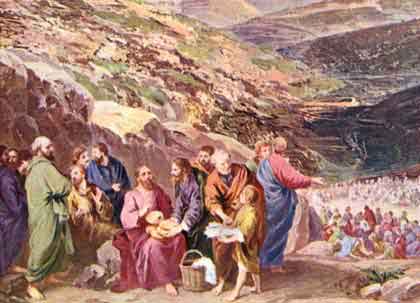
At least on two occasions, Jesus fed a multitude of hungry people who were following him. On one occasion, he fed about five thousand men besides women and children by blessing five loaves of bread and two fish (Matthew 14:13-21; Luke 9:11-17). On the other occasion, he fed about four thousand men besides women and children by blessing seven loaves of bread and a few fish (Matthew 15: 32-39). On both occasions, he did that upon his own initiative: “I have compassion on the multitude, because they have now continued with Me three days and have nothing to eat. And I do not want to send them away hungry, lest they faint on the way” (Matthew 15:32).
iii. Healing the sick
Jesus healed many people afflicted with a variety of ailments. He healed the leper (Luke 5: 12-15; 17: 11-19), the paralytic (Luke 5: 16-26), the paralyzed (Matthew 8: 5-13), the blind (Matthew 9: 27-31), a bleeding woman (Luke 8: 43-48), and those with a variety of diseases: “Then great multitudes came to Him, having with them the lame, blind, mute, maimed, and many others; and they laid them down at Jesus’ feet, and He healed them. So the multitude marveled when they saw the mute speaking, the maimed made whole, the lame walking, and the blind seeing; and they glorified the God of Israel” (Matthew 15: 30-31).
iv. Freeing the demon-possessed from demonic power
Jesus set many people free from demonic powers that possessed and tormented them. Demons knew that he was the Christ (Luke 4: 41; 8: 26-39; Mark 9: 17-29; Matthew 8: 16, 28-34; 9: 32-33; 12: 22-23). “Now in the synagogue there was a man who had a spirit of an unclean demon. And he cried out with a loud voice, saying, ‘Let us alone! What have we to do with you, Jesus of Nazareth? Did you come to destroy us? I know who You are—the Holy One of God!’ But Jesus rebuked him saying, ‘Be quiet, and come out of him!’ And when the demon had thrown him in their midst, it came out of him and did not hurt him. Then they were all amazed and spoke among themselves, saying, ‘What a word this is! For with authority and power He commands the unclean spirits, and they come out” (Luke 4: 33-36).
When they accused him of casting out demons by Beelzebub, the ruler of the demons, he declared that he cast out demons by the power of the living God: “But Jesus knew their thoughts, and said to them: “Every kingdom divided against itself is brought to desolation, and every city or house divided against itself will not stand. If Satan casts out Satan, he is divided against himself. How then will his kingdom stand? And if I cast out demons by Beelzebub, by whom do your sons cast them out? Therefore they shall be your judges. But if I cast out demons by the Spirit of God, surely the kingdom of God has come upon you. Or how can one enter a strong man’s house and plunder his goods, unless he first binds the strong man? And then he will plunder his house” (Matthew 12: 25-29; Luke 11: 17-23). In fact, Jesus terrified demons. They feared that he might send them to eternal torment before the time (Matthew 8: 29).
2. The Compassion of Jesus
(return to list of contents)
“And when Jesus went out He saw a great multitude; and He was moved with compassion for them, and healed their sick” (Matthew 14: 14).
i. Lamenting over the impending destruction of Jerusalem
Jesus foreknew the then future destruction of Jerusalem by the Romans, which took place in 70 AD. He wept over it with compassion: “Now as He drew near, He saw the city and wept over it, saying, if you had known, even you, especially in this your day, the things that make for your peace! But now they are hidden from your eyes. For days will come upon you when your enemies will build an embankment around you, surround you and close you in on every side, and level you and your children within you, to the ground; and they will not leave in you one stone upon another, because you did not know the time of your visitation” (Luke 19: 41-44).
ii. Raising the widow’s son from the dead
Jesus had compassion for the weeping widow who lost her only son. Therefore, he raised her son from the dead upon his own initiative: “And when He came near the gate of the city, behold a dead man was being carried out, the only son of his mother; and she was a widow. And a large crowd from the city was with her. When the Lord saw her, He had compassion on her and said to her, ‘do not weep.’ Then He came and touched the open coffin, and those who carried him stood still. And He said, ‘Young man, I say to you, arise.’ So he who was dead sat up and began to speak. And He presented him to his mother” (Luke 7: 12-15).
iii. Raising Lazarus from the dead
Lazarus and his two sisters were dear friends of Jesus. When Lazarus died, Jesus went to console his sisters and raise him from the dead. When Jesus saw Lazarus’ sister and friends weeping, he wept for their anguish and pain: “Therefore, when Jesus saw her weeping, and the Jews who came with her weeping, He groaned in the spirit and was troubled. And He said, ‘Where have you laid him?’ They said to Him, ‘Lord, come and see.’ Jesus wept” (John 11: 33-35).
3. Jesus: the Good Shepherd
(return to list of contents)
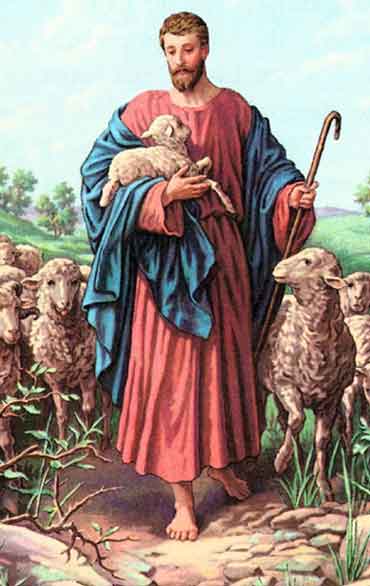
Jesus said: “I am the good shepherd. The good shepherd gives His life for the sheep. My sheep hear My voice, and I know them, and they follow Me. And I give them eternal life, and they shall never perish; neither shall anyone snatch them out of My hand” (John 10: 11, 27-28). Jesus searches for the lost sinner: “What man of you, having a hundred sheep, if he looses one of them, does not leave the ninety-nine in the wilderness, and go after the one which is lost until he finds it. And when he has found it, he lays it on his shoulders, rejoicing. And when he comes home, he calls together his friends and neighbors, saying to them, ‘Rejoice with me, for I have found my sheep which was lost!’ I say to you that likewise there will be more joy in heaven over one sinner who repents than over ninety-nine just persons who need no repentance” (Luke 15: 4-7); “For you were like sheep going astray, but have now returned to the Shepherd and Overseer of our souls” (1 Peter 2: 25).
We pray with the psalmist: “The Lord is my shepherd; I shall not want. He makes me to lie down in green pastures; He leads me beside the still waters. He restores my soul; He leads me in the paths of righteousness for His name’s sake. Yea, though I walk through the valley of the shadow of death, I will fear no evil; for You are with me; Your rod and your staff, they comfort me” (Psalms 23: 1-4).
4. The Holiness of Jesus
(return to list of contents)
From the above discussion it is apparent that Jesus did all goodness to all people. In addition, Jesus lived a pure holy life. He was blameless without sin: “Which of you convicts Me of sin?” (John 8: 46a); “Who committed no sin, nor was deceit found in His mouth; who, when he was reviled, did not revile in return; when He suffered, He did not threaten, but committed Himself to Him who judges righteously” (1 Peter 2: 22-23); “And you know that He was manifested to take away our sins, and in Him there is no sin” (1 John 3: 5); “Knowing that you were not redeemed with corruptible things, like silver or gold, but with the precious blood of Christ, as of a lamb without blemish and without spot” (1 Peter 1: 18a, 19).
5. The Humility of Jesus
 (return to list of contents)
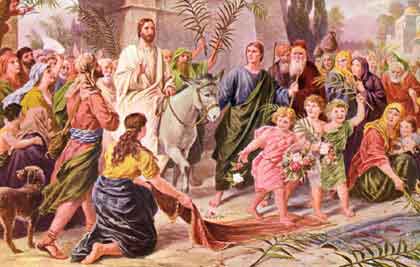
Jesus was a very humble person: “Take My yoke upon you and learn from Me, for I am gentle and lowly in heart, and you will find rest for your souls. For My yoke is easy and My burden is light” (Matthew 11: 29-30). When Jesus entered Jerusalem He was riding a young donkey, which symbolizes peace; he never used a horse that symbolizes war and conquest: “Then Jesus, when He had found a young donkey, sat on it; as it is written: ‘Fear not, daughter of Zion, behold, your King is coming sitting on a donkey’s colt” (John 12: 14-15).
Jesus befriended the sinner and the outcast in order to bring them to repentance: “And when the Pharisees saw it, they said to His disciples, ‘Why does your Teacher eat with tax collectors and sinners? When Jesus heard that, He said to them, ‘Those who are well have no need of a physician, but those who are sick; For I did not come to call the righteous, but sinners, to repentance” (Matthew 9: 11-12, 13b).
Jesus washed the feet of his disciples in order to teach them a lesson in humility: “After that, He poured water into a basin and began to wash the disciples feet, and to wipe them with the towel with which He was girded. So when He had washed their feet, taken His garments and sat down again, He said to them, ‘Do you know what I have done to you? You call Me Teacher and Lord, and you say well, for so I am. If I then, your Lord and Teacher, have washed your feet, you also ought to wash one another’s feet. For I have given you an example, that you should do as I have done to you” (John 13: 5, 12-15).
6. The Peaceful and Non-violent Nature of Jesus, the Prince of Peace
(return to list of contents)
Jesus never carried a sword or any weapon whatsoever. Jesus never asked anyone to kill somebody for him. In fact, when Peter, one of his chosen apostles, pulled his sword to prevent them from arresting Jesus, Jesus asked him not to use his sword: “And suddenly, one of those who were with Jesus stretched out his hand and drew his sword, struck the servant of the high priest, and cut off his ear. But Jesus said to him, ‘Put your sword in its place, for all who take the sword will perish by the sword. Or do you think that I cannot now pray to My Father, and He will provide me with more than twelve legions of angels? How then could the Scriptures be fulfilled, that it must happen thus?” (Matthew 26: 51-54). Subsequently, Jesus healed the ear of the servant of the high priest who came to arrest him (Luke 22: 51).
Jesus never organized an army, never invaded a country in the name of God, and never asked any of his disciples to do so for him. He did not come to establish an earthly kingdom or a state. In fact, he refused to become an earthly king: “Therefore, when Jesus perceived that they were about to come and take Him by force to make Him king, He departed again to the mountain by Himself alone” (John 6: 15).
There are many witnesses in the Holy Bible on the peaceful non-violent nature of Jesus. The following are a few of them: “He will not quarrel nor cry out, nor will anyone hear His voice in the streets” (Matthew 12: 19); “Because He had done no violence, nor was any deceit in his mouth” (Isaiah 53: 9b).
7. The Authority of Jesus, the Christ
(return to list of contents)
Many mighty miracles and works performed by Jesus are recorded in the books of the New Testament. These acts demonstrate his power and authority.
i. Authority to heal the sick
ii. Authority over demonic powers
iii. Authority to forgive sins
Jesus performed both physical healings and spiritual healings. The latter was effected mainly by forgiving the sins of the person: “When He saw their faith, He said to him, ‘Man, your sins are forgiven you.’ And the scribes and the Pharisees began to reason, saying, ‘Who is this who speaks blasphemies? Who can forgive sins but God alone?’ But when Jesus perceived their thoughts, He answered and said to them, ‘Why are you reasoning in your hearts?’ Which is easier, to say, ‘Your sins are forgiven you,’ or to say, ‘Rise up and walk?’ But that you may know that the Son of Man has power on earth to forgive sins’—He said to the man who was paralyzed, ‘I say to you, arise, take up your bed, and go to your house. Immediately he rose up before them, took up what he had been lying on, and departed to his own house, glorifying God” (Luke 5: 20-25; 7: 36-50). Jesus healed the paralytic man, but did that after He forgave his sins. He declared that He had the power to forgive sins. Jesus proved that he had the authority to forgive sins because, if he had committed blasphemy, He could not heal the paralytic man, which He did with ease. He did not speak on behalf of God. He spoke as God himself in self-revelation, saying: “I say to you …” (Matthew 5: 20, 22, 28, 32; etc.).
iv. Authority over human life
We know of three miracles of raising the dead (Luke 8: 41-42, 49-56; 7: 12-15; John 11: 1-44). The most powerful of these miracles is raising Lazarus from the dead four days after his death after his corpse began to decompose in his grave (John 11: 1-44).
v. Authority of creation
The miracles of multiplying the few loaves of bread and fishes to feed the hungry multitudes of people with plenty of left-over food which they collected in baskets are miracles of creation (Luke 9: 11-17; Matthew 15: 32-39).
Jesus created two new eyes for a man born blind (John 9). This man was born without eyeballs. Jesus created in him a pair of new eyeballs from clay that He anointed the blind man’s eye sockets with. This miracle reminds us of God’s creation of Adam from clay (Genesis 2:7).
vi. Authority over nature
Jesus rebuked the stormy wind and the raging sea, and they obeyed him (Matthew 8: 23-27; Mark 4: 36-41; Luke 8:22-25). He was able to command the forces of nature and they obeyed Him! In addition, Jesus walked on the raging sea as if it were dry land (Mark 6: 45-52).
III. COROLLARY
(return to list of contents)
People saw the glory of God in the loving compassionate attitude of Jesus, his teachings, and his mighty miracles. “The people who sat in darkness have seen a great light. And upon those who sat in the region and shadow of death, light has dawned” (Matthew 4: 16). They loved Jesus in great numbers drawn to him for his charismatic powers, and for his compassion and love. He equally responded to them.
In his first advent, Jesus Christ came to heal and regenerate spiritually those that would accept him, not to judge and condemn those who reject him, and not to build a world empire. He said: “And if anyone hears My words and does not believe, I do not judge him; for I did not come to judge the world but to save the world” (John 12: 47). He came to build, not to destroy. In his second advent, he will come back in glory and power to judge the living and the dead.
In his first advent, Jesus Christ has obtained the greatest victory in human history. He defeated both sin and spiritual death, the true enemies of humanity. His kingship is spiritual and universal but is not to be imposed on anyone. It is not associated with any earthly political power. In the Gospel, God offers eternal life with Christ to all who accept him as their Lord and savior. This offer remains in effect till the second advent of Christ. “Behold, He is coming with clouds, and every eye will see Him, even they who pierced Him. And all the tribes of the earth will mourn because of Him. Even so, Amen. ‘I am the Alpha and the Omega, the Beginning and the End,’ says the Lord, ‘who is and who was and who is to come, the Almighty’” (Revelation 1: 7-8).
Jesus loves you. He searches for you saying: “Behold, I stand at the door and knock. If anyone hears My voice and opens the door, I will come in to him and dine with him, and he with me” (Revelation 3: 20). Would you open the door of your heart for him? Please, contemplate it.

For additional information, please visit the following pages: